About Discounts
Last updated: November 17, 2026
This document provides a detailed look at discounts within gaiia, how they work, and how to set them up.
What are Discounts?
Discounts are a credit applied to an account or at invoice generation. They can be used immediately to reduce the amount on an invoice or added to an account's "Available Funds" for future use.
Types of Discounts
Within gaiia, there are three types of discounts: one-time, recurring, and automated discounts. They generally differ in their frequency of application.
One-time discounts
Added with the Credit account option of the
+ Transactionbutton, in the Transactions area of an account.Can be applied to multiple invoices (if the amount is large enough).
Work almost like a payment when added to an invoice.
Increase the "Available funds" of an account (unless immediately used).
The value of the discount is determined at the time of application by a user.
Recurring discounts
Added to an account as a subscription.
Only applied each time a recurring invoice is generated.
Applied only to the recurring invoice.
Can be a flat dollar amount or a percentage of the invoice subtotal (before taxes).
Generally always a "fixed" amount, defined within the product catalog (e.g., always $5 off or 10%). Users with the
Override subscription pricepermission can set a custom amount or percentage for one account when assigning it.
Automated discounts
Automatically created by gaiia.
Work very similarly to one-time discounts in their application.
Only apply when:
Proration is required in the event of things like cancellations, subscriptions being added mid-cycle, etc.
When invoices are write-offs are being done
How to Apply One-Time Discounts
Please Note: One-time discounts are credits added directly to an account. They are based on a subscription, a product catalog item, or a custom amount.
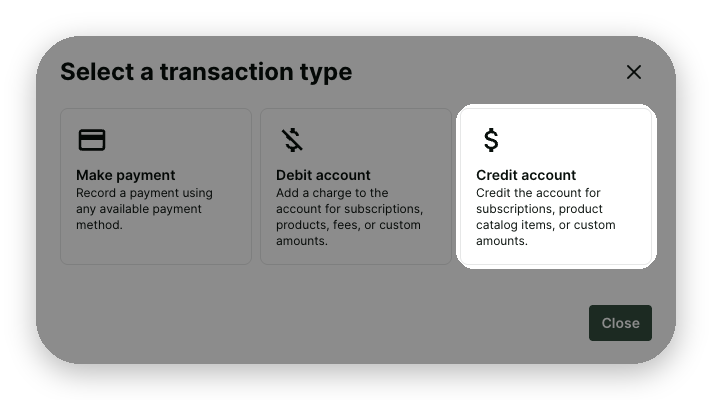
To apply a one-time discount, open the account’s Billing tab, select Transactions and click + Transaction. In the Select a transaction type window, choose Credit account.
The Credit account window offers three options to help create the discount.
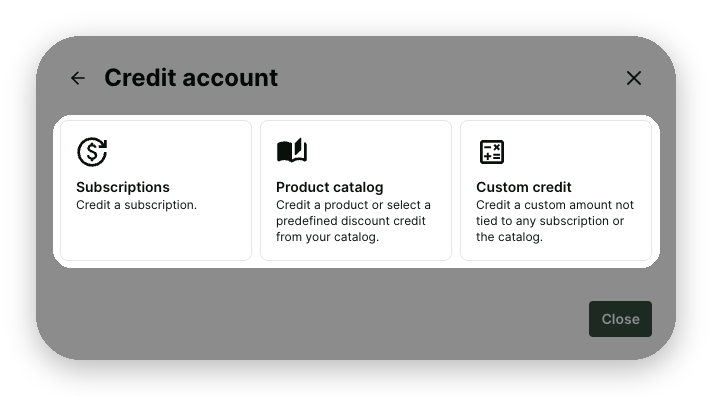
Each option only appears for users with the permission to apply that type of discount.
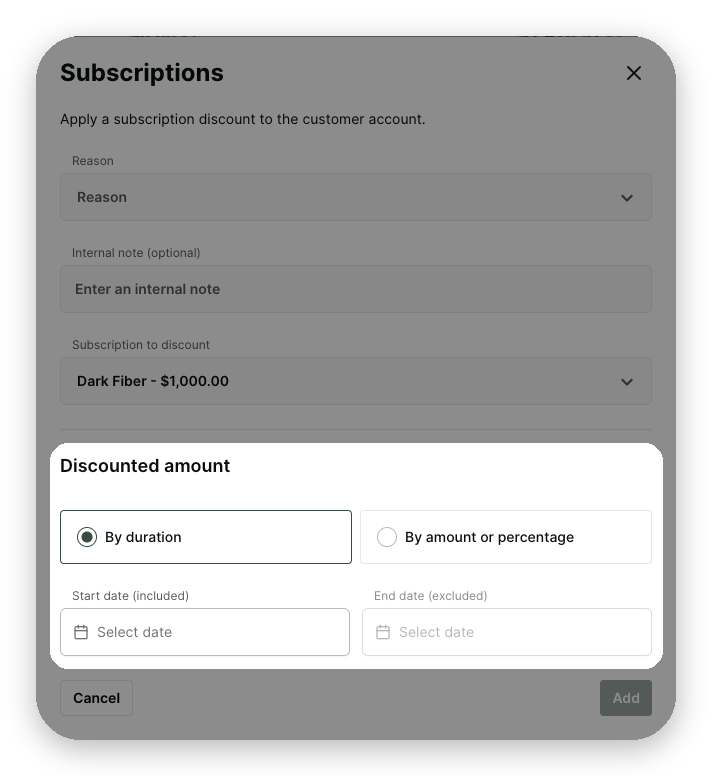
Subscriptions
Credits the account based on any of its subscriptions. A subscription must exist on the account (in any status) to create a discount based on it.
Reason - Used to track the reason for the discount. A list of available options is presented to the user, and the reason helps audit and report on why discounts occurred.
Internal note (optional) - A note kept on the transaction for internal reference.
Subscription to discount - The subscription that the discount will be based on.
Discounted amount
By duration - Credits the subscription for a calendar period, from a Start date (included) to an End date (excluded). gaiia calculates the discount amount from the period and the subscription price. The period can’t be longer than the account’s billing frequency (one month for monthly billing). When part of the cycle hasn’t been billed yet, a Fill the unbilled period until the next billing cycle checkbox fills in the dates for you.
By amount or percentage - The discount is created based on a dollar amount or a percentage. Regardless of the method, the resulting discount amount cannot exceed the current price of the subscription.
Users with the Apply price overrides higher than the original price permission can go beyond these limits.
Product catalog
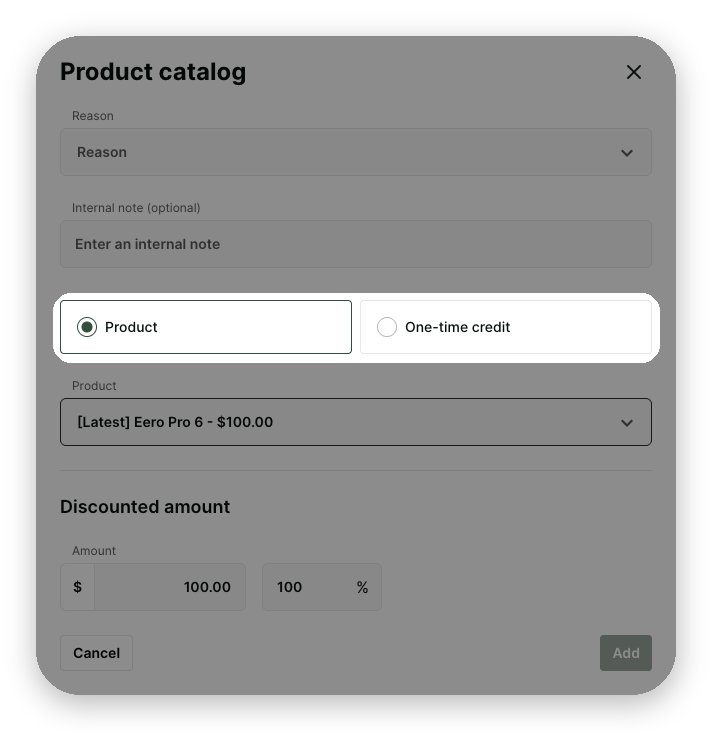
Credits the account based on an item from the product catalog.
Reason - Used to track the reason for the discount. A list of available options is presented to the user, and the reason helps audit and report on why discounts occurred.
Internal note (optional) - A note kept on the transaction for internal reference.
Product - Pick a one-time product or fee in the Product list, then set the Amount under Discounted amount, in dollars or as a percentage. The resulting discount amount cannot exceed the product price defined within the product catalog.
One-time credit - Pick a predefined one-time discount from the product catalog in the Credit list. It is applied as it is configured in the catalog.
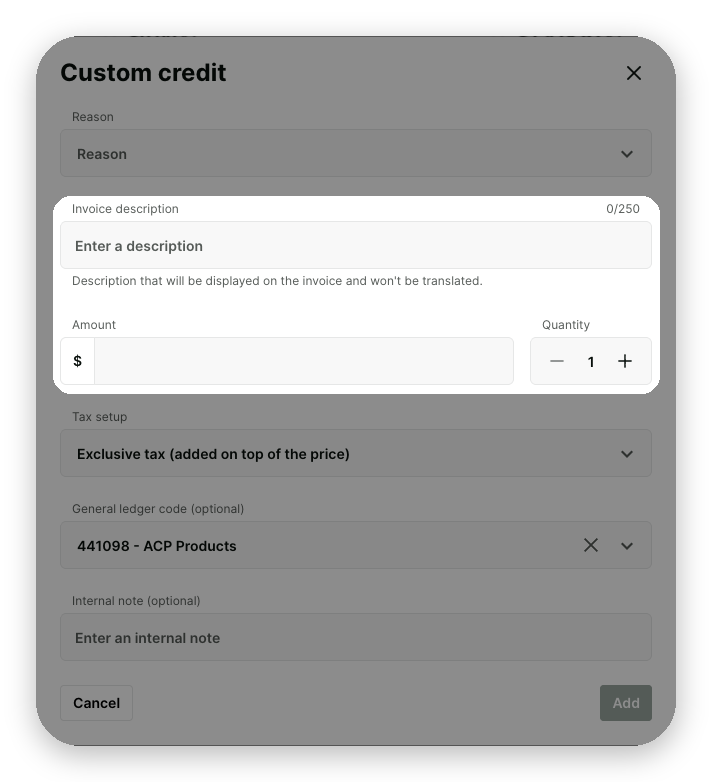
Custom credit
As the name suggests, a custom credit is a customized discount not based on any subscription or product within gaiia.
Reason - Used to track the reason for the discount. A list of available options is presented to the user, and the reason helps audit and report on why discounts occurred.
Invoice description - The text that will appear on the invoice when the discount is applied (up to 250 characters, not translated).
Amount - The overall dollar value of the discount. Must be a minimum of $0.01.
Quantity - Defines how many times the discount is applied to the account. Always defaults to 1.
Tax setup - Whether tax is calculated on the discount: Don’t charge tax, Exclusive tax (added on top of the price, the default), or Inclusive tax (included in the price).
General ledger code (optional) - Used for financial reporting.
Internal note (optional) - Allows a note to be tracked on the discount transaction on the account for internal reference and reporting.
Pro Tip: A limit can be set to restrict the maximum value a custom credit can be. This is set by the "Maximum custom discount amount" billing setting, in the Other tab of the billing settings. When it is set, the Amount field shows the maximum.
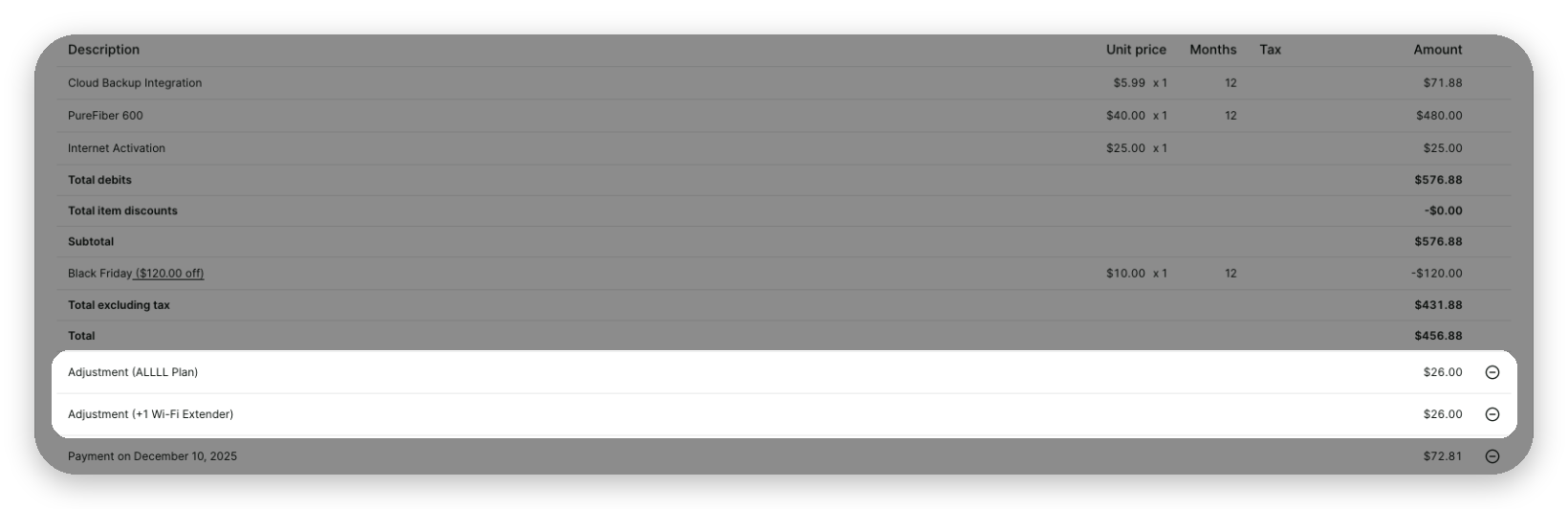
How One-Time Discounts are Applied to Invoices
One-time discounts, as discussed earlier, are essentially a credit applied to any invoice. Therefore, they work like a payment applying to the overall invoice total and appear in the same area on the invoice, below the total.
With the default Exclusive tax setup, the discount will also affect the tax, which is built into the discount itself. This is done by taking a $10 discount and including the appropriate tax value as part of the overall discount amount. For example, a $10 discount with a 5% tax would become $10.50.
How to Apply Recurring Discounts
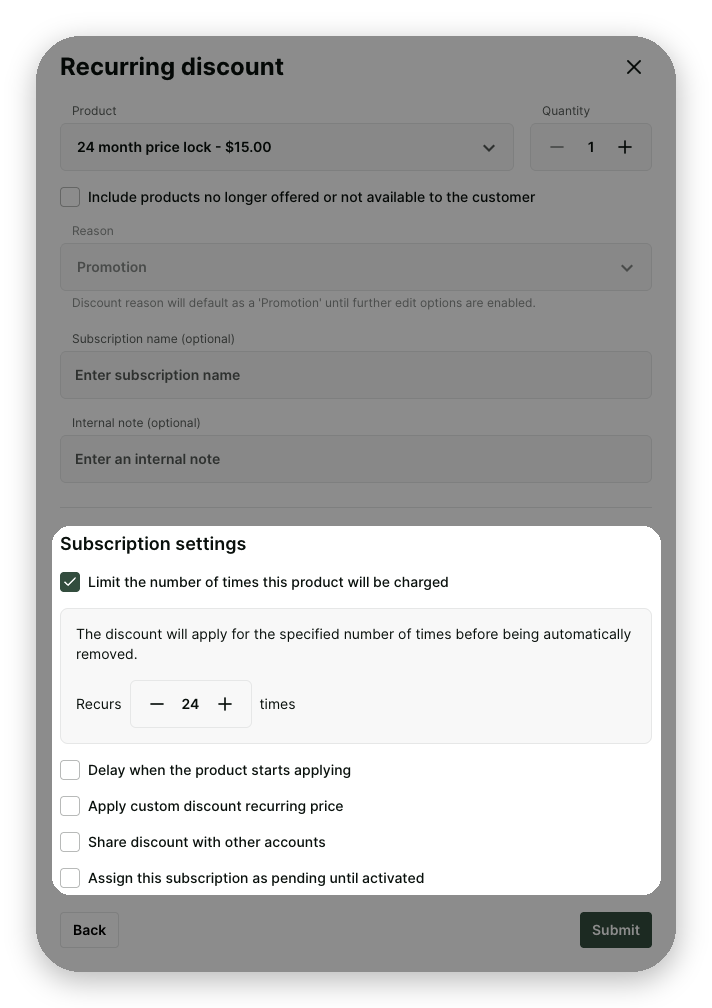
Recurring discounts work like a subscription on an account which is automatically applied to a recurring invoice each time it is generated. Therefore, like subscriptions for internet services, they must be assigned to the account first through the Subscriptions area.
Click the + Subscriptions button, then choose Recurring discount in the Select a subscription type window. The Recurring discount window contains these fields:
Product - The discount that will be applied to the account. Both percentage and dollar discounts configured within the product catalog will appear.
Include products no longer offered or not available to the customer - Also lists discounts that are no longer offered. Only shown to users with the permission to assign unavailable products.
Reason - Used to track the reason for the discount within reporting and auditing. Currently, only the "Promotion" reason can be assigned (although this will be changed in the future).
Subscription name (optional) - A name for this subscription on the account.
Internal note (optional) - A note for internal reference.
Subscription settings - How many times the discount applies, and how many invoice cycles it waits before it starts. Both are filled in from the Product Catalog and can be adjusted for this account. See Creating and Using Expiring Subscriptions.
Apply custom discount recurring price - For a dollar discount, sets a different amount for this account only. Enter the New unit price and a Reason. The discount in the product catalog is not changed.
Apply custom discount recurring percentage - For a percentage discount, sets a different percentage (1 to 100) for this account only, with a Reason.
Share discount with other accounts - Splits the discount between up to 3 payers. Only available for dollar discounts without a recurrence limit in the product catalog.
Assign this subscription as pending until activated - Adds the discount as "Pending" until the subscription is activated.
Create a prorated discount - Applies a prorated credit for the current billing cycle. Only available for dollar discounts, and hidden when a recurrence limit or delay is set, or when the subscription is assigned as pending. On the day an invoice is generated, the option reads Create full discount (recommended).
The two custom price options only appear for users with the Override subscription price permission enabled. The recurrence limit and delay settings appear for every user who can assign subscriptions.
Configuring Discounts
Discounts are configured directly within the product catalog, like you would a product or fee. In the sidebar, open Products, select Discounts, then click New discount. For a full walkthrough, see Creating a Discount.
When configuring a discount, many of the same fields are present when configuring a product or fee. The fields have been explained below:
Name - The name of the discount. Keep in mind, this is what will appear to your customers as well, unless overwritten in translations.
Slug - Only appears in reporting and the product catalog. A unique id that is created automatically from the name to help identify the discount.
Description - Used for internal identification only. Allows you to provide a brief summary of the discount and what it is used for.
Payment strategy - Keep as recurring (the default). This will allow it to be applied to a recurring invoice.
Price-based / Percentage-based - Specifies whether the discount being created is a dollar or percentage one. Percentage-based is only available with the recurring payment strategy.
Currency - The currency of the discount. It is filled in with your default currency.
Price/Percentage - If configuring a dollar discount, the total dollar value of the discount. If configuring a percentage discount, enter the percentage of the discount in this field.
Tax setup - How tax applies to the discount: Don’t charge tax, Exclusive tax (added on top of the price) or Inclusive tax (included in the price). Percentage discounts only apply to the subtotal of an invoice.
Limit the number of times the discount will recur on an account - In Additional Settings, limits how many times it is applied to an invoice before expiring. Discussed in more detail in this article: Creating and Using Expiring Subscriptions.
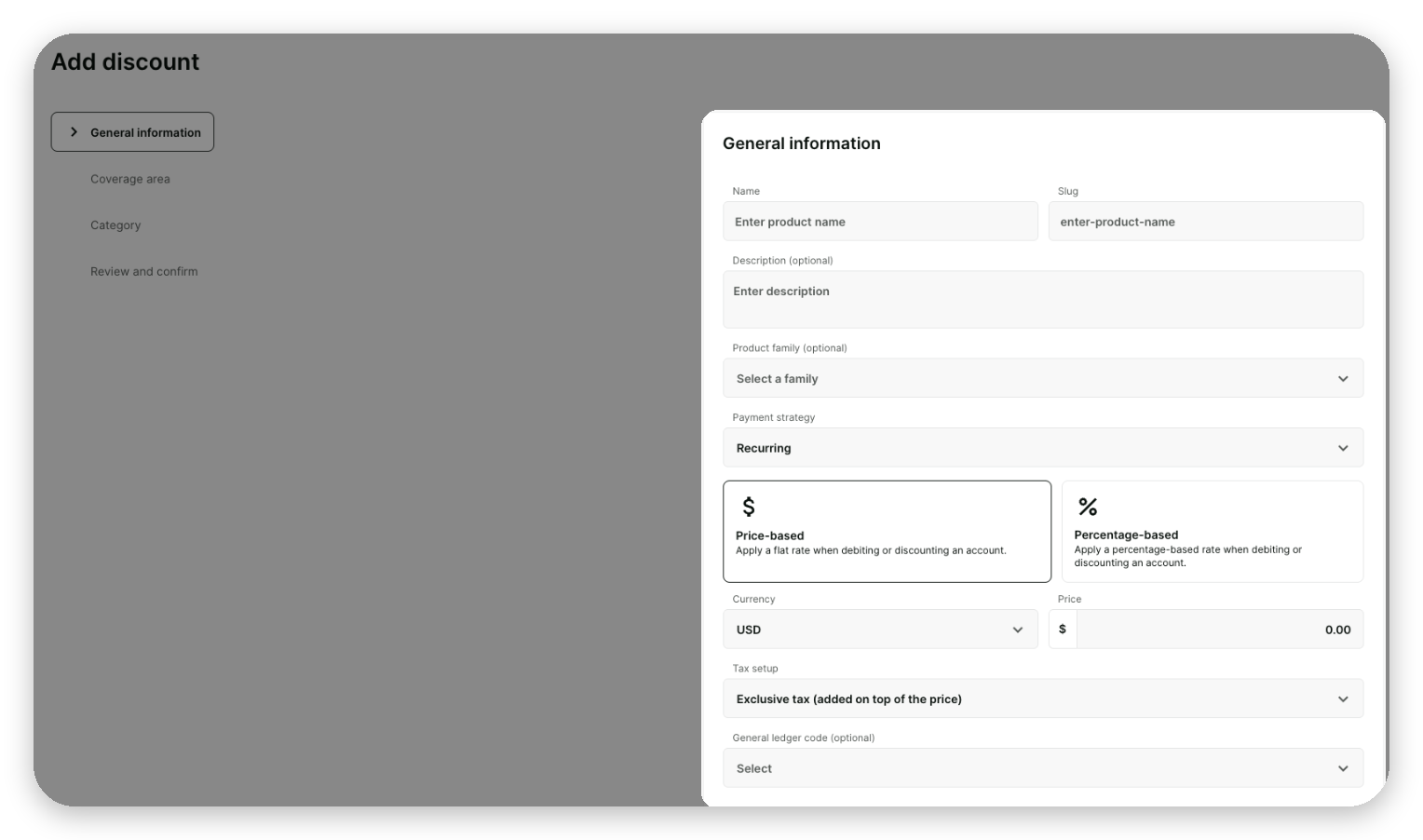
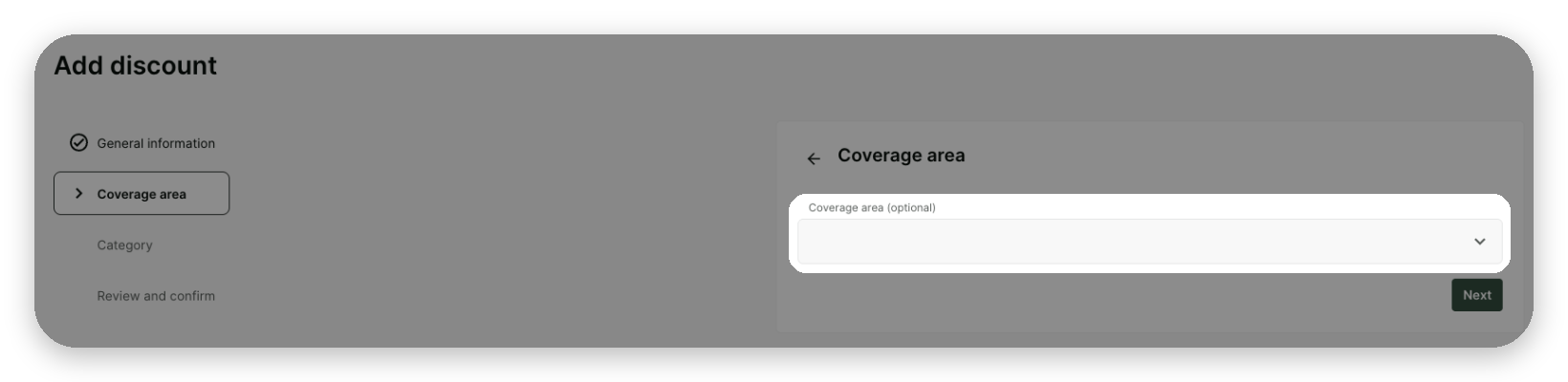
Once the main details of the discount have been defined, you can select the coverage areas it belongs to. This step is optional.
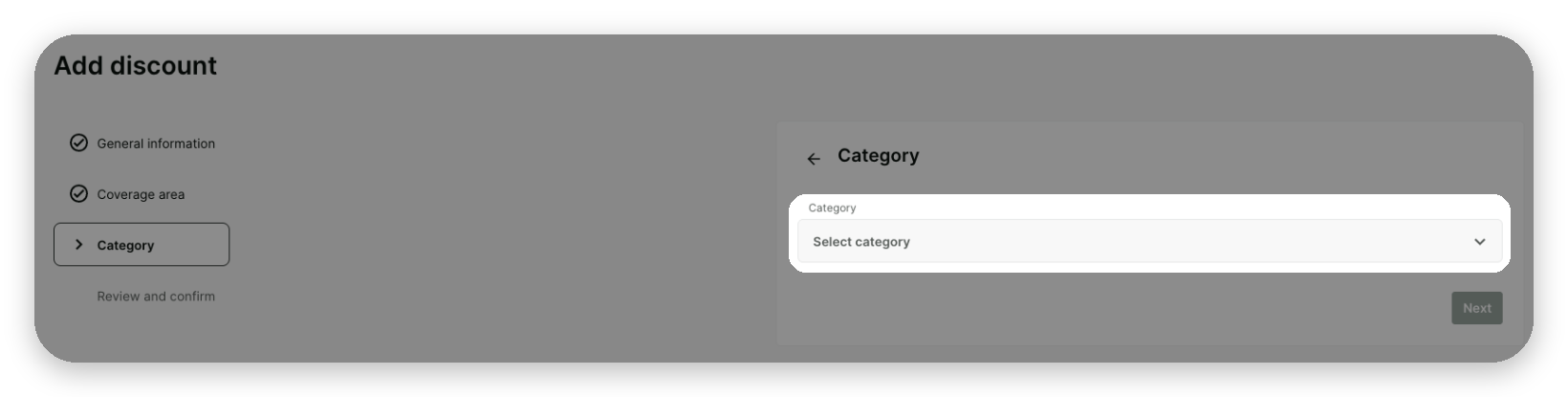
Lastly, select the category it belongs to as well.
Please Note: Like products and fees, restrictions are imposed on editing key details of it such as the amount. Should updates be required, a new product version can be created. This new version will only affect new customers receiving the discount.
How Recurring Discounts are Applied to Invoices
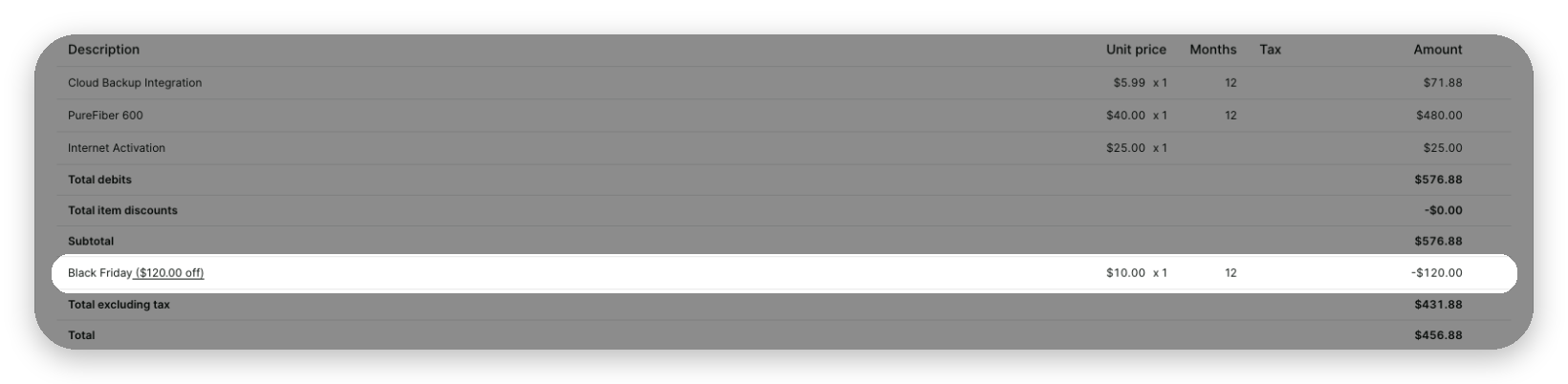
Recurring discounts, since they are also being applied to an invoice, always affect the subtotal before any taxes or other payments have been applied. This applies to both types of recurring discounts: dollar and percentage. The discount line appears after the Subtotal, before tax.
Expiring Discounts
Recurring discounts can also be set up to expire. A detailed article walks through how they work and are set up. It can be found by accessing this link: Creating and Using Expiring Subscriptions.
Tracking Discounts in Reporting
The "Discounts Applied" report will be the primary report used to track any discounts that were applied. It provides details on every discount applied to an invoice. Paired with the "Invoiced Revenue" report, it can provide a complete picture of all discounts that occurred within a particular time frame and how they affected invoices.
Tracking Discounts in Snowflake
The relevant tables to track discounts within Snowflake include:
TRANSACTION (filtered by the "DISCOUNT" transaction type)
INVOICE
DISCOUNT
CREDIT (how a discount is applied to an invoice)
DISCOUNT_REASON